Just been in a crash? Move yourself and your passengers to a safe spot away from traffic, call 911 if anyone is hurt, document the scene with photos, then arrange accident towing. Twin Cities Towing INC responds to accident scenes across Fort Bend County 24/7 — call (281) 935-1113 once the scene is secure.
The decisions you make at the scene affect your safety, your insurance claim, and what the recovery costs you. This guide walks through the whole sequence for Fort Bend County drivers — from the first minute on the shoulder of I-69/US-59 to picking your car up from a storage lot. For the broader picture, see our complete guide to towing in Richmond, TX.
This article is general information for drivers, not legal advice. For questions about fault, liability, or a specific claim, talk to your insurer or a licensed Texas attorney.
What Should You Do in the First Ten Minutes After a Crash?
Get out of the traffic lane, check for injuries, and make the scene visible before you do anything else. On high-speed corridors like I-69/US-59, the Grand Parkway (SH-99), FM 762, or FM 359, a secondary collision is the biggest danger after the first one — so safety comes before photos, paperwork, or phone calls to anyone but 911.
-
Stop and get clear of traffic
Texas law requires you to stop. If the car is drivable, pull onto the shoulder or the nearest parking lot — do not stay in a live lane on US-59 or the Grand Parkway to "preserve the scene." If it will not move, leave it, exit away from traffic, and get behind a barrier.
-
Check for injuries and call 911
Check yourself, your passengers, and the other driver. If anyone is hurt — even "just shaken up" — call 911. Adrenaline masks injuries, so err on the side of a medical check.
-
Make yourself visible
Hazard lights on immediately. If you carry reflective triangles or flares and can place them safely, set them well behind the vehicles — especially at night on unlit stretches of FM 762 or FM 359.
-
Exchange information
Name, phone number, driver license number, license plate, and insurance carrier with policy number — for every driver involved. Photograph their insurance card instead of copying it by hand.
-
Photograph everything
Wide shots of the whole scene, close-ups of damage on every vehicle, skid marks, debris, traffic signs, and the roadway itself. Capture the location context — a mile marker, cross street, or exit sign.
-
Get witness and officer details
Ask witnesses for a name and phone number before they drive off. When an officer arrives, note their name, agency, and the crash report number they give you.
-
Arrange your tow
If the vehicle cannot be driven safely, call Twin Cities Towing INC at (281) 935-1113 for priority accident towing dispatch anywhere in Fort Bend County.
When Does Texas Law Require You to Call the Police?
Texas requires a crash to be reported to law enforcement when it involves injury, death, or apparent damage that leaves a vehicle unable to be normally and safely driven. A police-investigated crash report is also required when total apparent damage reaches $1,000 — a threshold almost any modern bumper repair exceeds. In practice: if the crash is more than a parking-lot tap, call.
There is a practical reason to call beyond the legal one: the officer's crash report (the CR-3, covered below) is the single most useful document in your insurance claim, and it only exists if an officer investigates. Who shows up depends on where you crash — Fort Bend County has overlapping jurisdictions, and knowing which agency worked your wreck matters when you request the report.
Inside Richmond City Limits
The Richmond Police Department typically investigates crashes on city streets — around the Historic Downtown grid, Jackson Street, and the US-90A corridor through town. Request your report through Richmond PD's records division.
Unincorporated Fort Bend County
The Fort Bend County Sheriff's Office covers unincorporated areas — much of the FM 762 and FM 359 mileage, plus neighborhoods outside city limits. DPS troopers may work crashes on I-69/US-59 and the Grand Parkway. Note the agency on scene so you request the report from the right records office.
What Should You Document Beyond the Basics?
Beyond the driver exchange, document the conditions: time of day, weather, traffic, and anything unusual — a missing sign, standing water, construction barrels. Do not discuss fault at the scene or apologize reflexively; state facts to the officer and let the investigation assign responsibility.
Two habits pay off later. Photograph your car's interior damage and any deployed airbags — insurers ask. And before the tow truck leaves, photograph the vehicle on the flatbed and note the destination address, so you always know exactly where the car went and when.
How Do Texas Crash Reports Work — the CR-2 and the CR-3?
Texas has two crash report forms. The CR-3 is the official peace officer's crash report, filed with TxDOT whenever an officer investigates a qualifying crash. The CR-2 — the "blue form" — is the driver's own crash report for wrecks no officer investigated. Since 2017, TxDOT no longer collects CR-2s, but the form is still worth completing for your records and your insurer.
To get your CR-3, use TxDOT's online Crash Report purchase system. Reports are generally available about ten days after the crash; a standard copy runs about $6 and a certified copy about $8. You will need basic details — date, county, and a driver name — to find it. Your insurance adjuster will ask for the report number early in the claim, so order it promptly.
If no officer came to the scene — common for minor wrecks moved off the road quickly — download the CR-2 from TxDOT, fill it out while your memory is fresh, and keep a copy with your photos in case the other driver's story changes later.
Who Chooses the Tow Company After a Wreck — You or the Police?
In most situations, you do. Texas law distinguishes between consent tows — where you pick the company and the destination — and police-ordered tows, which an officer can direct when a vehicle is blocking traffic, creating a hazard, or when the driver is injured and cannot make arrangements. If your car is on the shoulder and you are able to decide, you can call the towing company you want.
The distinction matters financially. A consent tow goes once, directly to the body shop or driveway you choose, at a rate you confirmed on the phone. A police-ordered tow goes to a licensed vehicle storage facility, where daily storage charges start stacking on top of the tow itself — and then you still need a second tow to get the car to a repair shop. If the officer needs the lane cleared immediately, that call is theirs to make; but when you have the option, requesting your own tow usually saves both money and a trip to the storage lot. We break down the consent rules, notice requirements, and fee protections in detail in Texas towing laws and your rights.
How Does Accident Towing Actually Work in Fort Bend County?
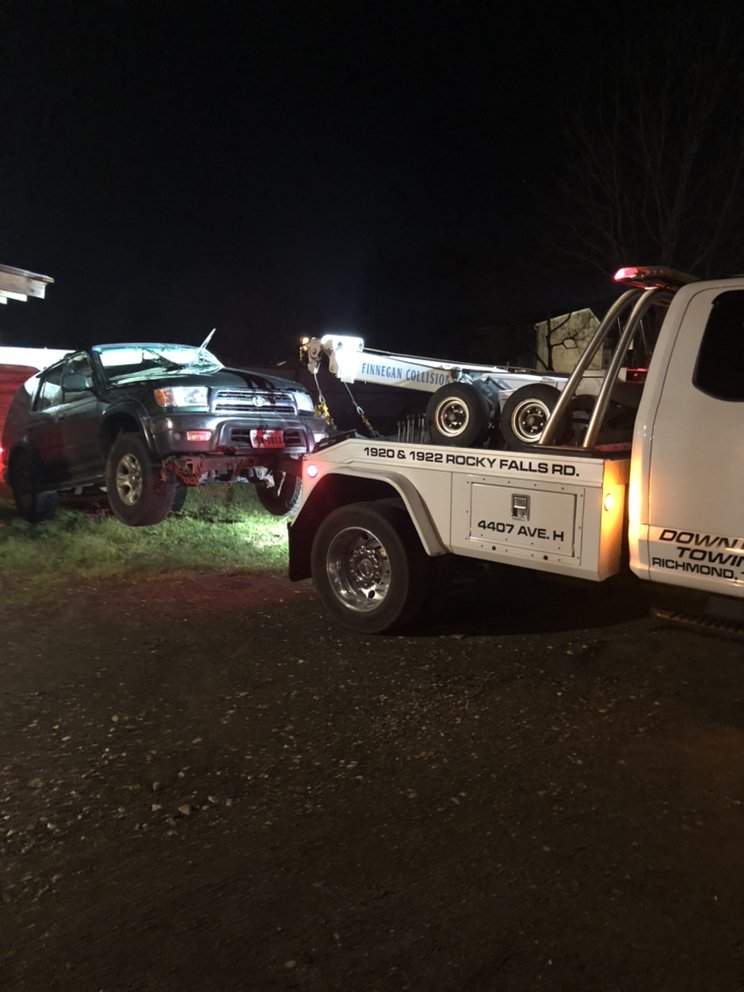
Accident tows are priority dispatch: Twin Cities Towing INC targets 20–40 minute arrival across Fort Bend County, faster when lanes are blocked on I-69/US-59 or the Grand Parkway. The driver secures the scene, coordinates with the officer on clearance, winches the vehicle onto a flatbed, and delivers it to the shop you choose — with documentation for your insurer.
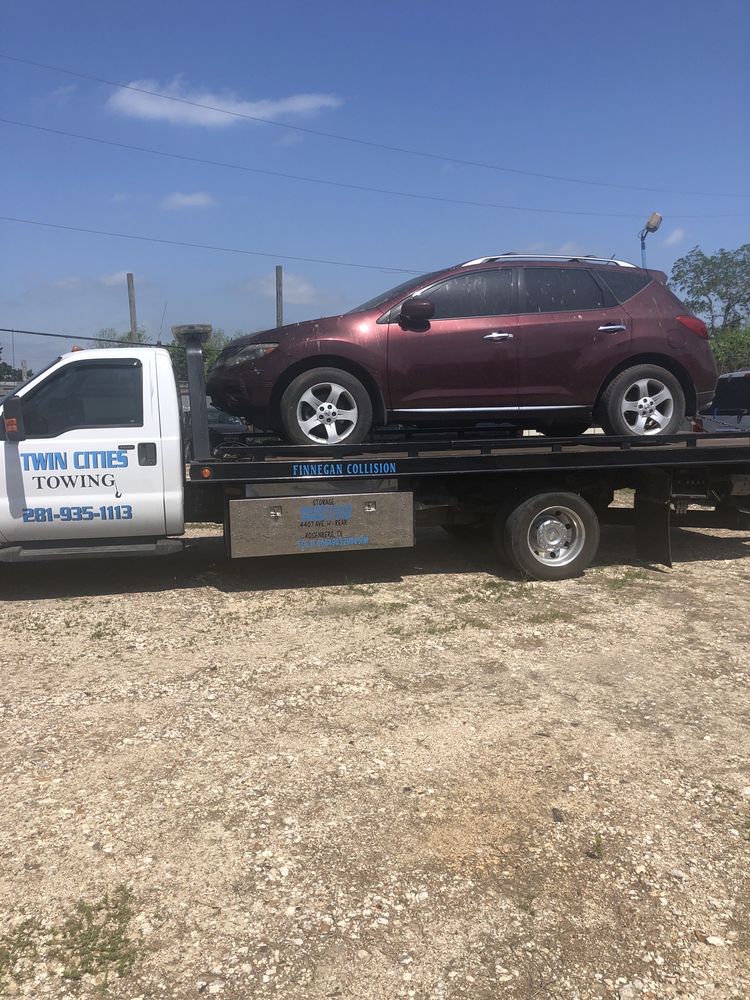
Crash-damaged cars usually cannot be towed the way a broken-down car can. Seized wheels, blown tires, and bent suspension mean the vehicle will not roll onto a wheel-lift — it has to be winched up the deck of a flatbed under control, without dragging anything that adds damage. That is why flatbed towing is the default for collision recovery, and why our accident towing trucks carry winches rated for non-rolling loads. Our drivers work alongside the Fort Bend County Sheriff's Office, Richmond PD, and DPS regularly, so scene protocol — where to stage the truck, when the lane reopens, what the officer needs before releasing the vehicle — is routine, not improvised.
Since 2011 we have cleared crash scenes from the US-59 frontage roads in Rosenberg to the Grand Parkway interchanges near Greatwood. Tell the dispatcher your location, whether the car rolls, and where you want it delivered.
How Should You Handle the Insurance Claim?
Report the crash to your insurer the same day if you can, even when the other driver seems at fault. Give facts — location, time, vehicles, the investigating agency — and let the adjuster work from the CR-3 report. Keep every receipt: towing invoice, storage fees, rental car. Photographed evidence plus the officer's report does most of the persuading for you.
A few Texas-specific notes. If the other driver was uninsured, your own uninsured motorist coverage responds — one more reason to involve police and get the report on record. Scene towing is normally part of the collision claim, and we provide the itemized invoice insurers expect. And if an adjuster steers you toward a preferred shop, remember the repair-shop choice in Texas is yours, just like the tow.
How Do You Get Your Car Back From a Storage Lot?
If your vehicle went to a vehicle storage facility after a police-ordered tow, go as soon as possible — storage fees accrue daily from the moment it arrives. Bring a government-issued ID and proof you own or control the vehicle, such as the title, registration, or insurance card. Licensed Texas storage facilities must accept payment by card, and the facility is required to give you an itemized statement of charges.
You can retrieve essential personal property — medication, documents, child seats — even if you are not releasing the car yet. If law enforcement placed an investigative hold on the vehicle, the facility cannot release it until the agency clears the hold, so call the investigating department first. Once released, the car does not have to be driven out damaged: schedule a car towing pickup from the lot to your repair shop so it only moves once.
The best prevention: when you have the choice at the scene, have the vehicle towed directly to its final destination. A single consent tow — with roadside assistance on standby if the car turns out to be drivable — costs a fraction of a storage-lot detour.
Fort Bend County Accident Towing FAQs
Do I have to use the tow truck the police call after an accident in Texas?
Not always. If your vehicle is not blocking traffic and you can make arrangements at the scene, you can generally request the towing company of your choice. If the vehicle is blocking a lane or you are being transported for medical care, the officer can order an immediate tow from the department's rotation list to clear the scene.
How do I get a copy of my Texas crash report (CR-3)?
When an officer investigates your crash, they file a CR-3 peace officer's crash report with TxDOT. You can purchase a copy through TxDOT's online Crash Report system, usually within about 10 days of the crash. A regular copy costs around $6 and a certified copy around $8. Your insurance company will typically want the report number.
Will my insurance pay for accident towing in Fort Bend County?
Most policies with collision coverage treat towing from an accident scene as part of the claim, and many also include separate towing or roadside reimbursement. Keep your towing invoice — Twin Cities Towing INC provides documentation with the pickup location, destination, and service details that insurers ask for.
What happens if my car is towed to a storage lot after a wreck?
Police-ordered tows go to a licensed vehicle storage facility, where daily storage fees start accruing. Bring your ID and proof of ownership to retrieve the vehicle or your belongings; if law enforcement placed a hold, you will need a release first. Retrieving the car quickly — or having it towed straight to your chosen shop — keeps fees down.
In a Wreck Right Now? We Answer 24/7.
Twin Cities Towing INC has cleared accident scenes across Richmond, Rosenberg, and greater Fort Bend County since 2011 — priority dispatch, flatbed recovery, and insurance-ready documentation on every accident call.